BESS4 Eligibility: Which NSW Businesses Qualify for the Battery Incentive
A NSW business qualifies for BESS4 if it installs a battery with usable capacity between 20 kWh and 200 kWh, behind the meter, using a battery listed on the Clean Energy Council's approved battery list. Solar panels are not required. BESS4 is part of the NSW Peak Demand Reduction Scheme and started on 1 September 2026.
What is BESS4?
BESS4 is a new activity under the NSW Peak Demand Reduction Scheme (PDRS), administered by IPART. It gives small and medium businesses a financial incentive to install a battery that reduces electricity demand during peak periods. The activity started on 1 September 2026, alongside BESS5 for larger commercial and industrial batteries and BESS3 for apartment buildings.
Status: Active, from 1 September 2026. Source: NSW DCCEEW, Energy Security Safeguard position paper, July 2026.
Businesses earn the incentive through Peak Reduction Certificates, created and traded by an Accredited Certificate Provider on the business's behalf.
Most businesses won't deal with certificates directly — an installer such as 3P Solar handles that step through its commercial solar and solar battery packages, and passes the value on as an upfront discount on the system.
Battery size: the first eligibility test
To qualify for BESS4, a battery's usable capacity has to sit between 20 kWh and 200 kWh. This range covers most small and medium business installations, from a single warehouse battery to a larger commercial system.
A battery smaller than 20 kWh won't qualify for BESS4 — that size sits below the scheme's threshold. A project needing more than 200 kWh instead falls under BESS5, which covers systems up to 10 MWh.
It's usable capacity, not the manufacturer's advertised nominal capacity, that decides whether a battery fits the BESS4 range. Under the current NSW rule, usable capacity is calculated as 90% of the battery's nominal capacity as listed on the Clean Energy Council's approved product list.
Do you need solar panels to qualify?
No. Solar PV is not a requirement for BESS4.
NSW confirmed this directly in its July 2026 Energy Security Safeguard position paper, stating that on-site solar shouldn't be mandatory, because it would exclude businesses that use a battery mainly to cut demand charges or shift load in response to electricity prices, rather than to store solar energy.
That said, the incentive works on two tiers: a standard incentive when a new battery is installed alongside new solar PV capacity, and a lower incentive for battery-only installations. So solar isn't required, but pairing a new battery with new solar generally unlocks the stronger of the two rates.
Other eligibility requirements
Beyond battery size, a handful of other conditions decide whether a business project qualifies:
- Approved equipment. The battery must be listed on the Clean Energy Council's approved battery list. For modular systems, each module needs its own listing rather than the combined system.
- Behind-the-meter installation. The battery has to sit behind the meter at the business site, reducing that site's own demand — BESS4 doesn't cover batteries operating mainly as market-facing supply assets.
- One claim per site. A site can only run the BESS4 (or BESS5) activity once. After certificates are created, that site can't claim under either activity again.
- Council approval. Projects need either a complying development certificate or a development application, depending on the installation.
- Minimum co-payment. Businesses contribute at least $5,000 towards the cost of the system — the incentive reduces the price, it doesn't cover it outright.
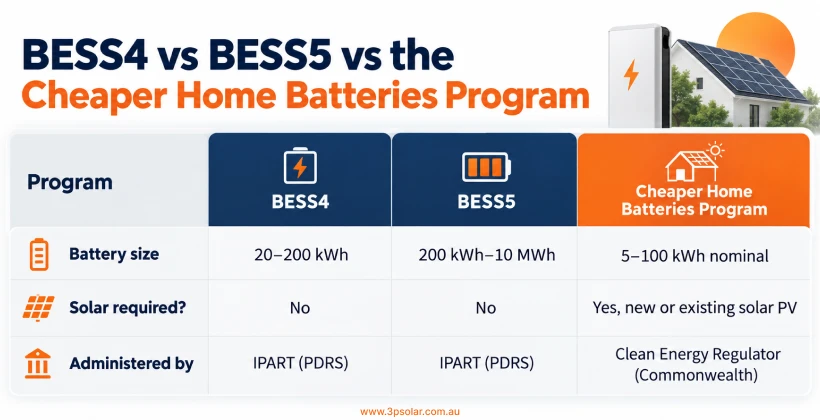
BESS4 vs BESS5 vs the Cheaper Home Batteries Program
BESS4 sits alongside two other battery programs a NSW business might come across. Here's how the three compare:
| Program | Battery size | Solar required? | Administered by |
|---|---|---|---|
| BESS4 | 20–200 kWh | No | IPART (PDRS) |
| BESS5 | 200 kWh–10 MWh | No | IPART (PDRS) |
| Cheaper Home Batteries Program | 5–100 kWh nominal | Yes, new or existing solar PV | Clean Energy Regulator (Commonwealth) |
Some smaller BESS4 projects can potentially also meet the separate requirements of the federal Cheaper Home Batteries Program, since NSW allows stacking with that program for batteries under 100 kWh. Each program has its own eligibility rules, so a project needs to independently meet both sets of requirements to receive both incentives.
How to check your eligibility
Before applying, work through this checklist:
- Confirm the planned battery's usable capacity sits between 20 kWh and 200 kWh.
- Check the battery model is listed on the Clean Energy Council's approved battery list.
- Confirm the installation will be behind the meter at your business site.
- Check your site hasn't already claimed BESS4 or BESS5 in the past.
- Budget for a minimum co-payment of $5,000 towards the system cost.
- Decide whether to pair the battery with new solar PV for the higher incentive tier, or proceed battery-only.
3P Solar can run this check for you as part of a solar package consultation, alongside a look at current solar rebates your business may also be able to access.

Key takeaways
- BESS4 covers NSW business batteries between 20 kWh and 200 kWh, active from 1 September 2026.
- Solar panels are not required, though pairing solar with the battery unlocks a higher incentive tier.
- The battery must be Clean Energy Council-listed and installed behind the meter.
- Each business site can claim BESS4 (or BESS5) only once.
- A minimum $5,000 co-payment applies, and council approval is required.
Frequently Asked Questions
BESS4 commenced on 1 September 2026, as confirmed in the NSW DCCEEW Energy Security Safeguard position paper (July 2026).
Yes. Solar PV is not a requirement for BESS4, though battery-only projects receive the lower of the two available incentive tiers.
Usable capacity between 20 kWh and 200 kWh. Larger systems may instead qualify under BESS5.
No. Each site can only claim BESS4 or BESS5 once. After certificates are created for either activity, that site is no longer eligible for either again.
Yes. Projects need either a complying development certificate or a development application, depending on the installation.