Cheaper Home Batteries Program Explained: What Changed in 2026
The Cheaper Home Batteries Program is an ACTIVE federal scheme giving Australian households around a 30% discount on eligible solar batteries. On 1 May 2026, the government changed how that discount is calculated: batteries above 14 kWh now receive a reduced rate on the extra capacity.
If you've been researching solar batteries lately, you've probably come across the Cheaper Home Batteries Program. It's the single biggest reason battery uptake has surged across Australia, but the way the discount is calculated changed on 1 May 2026, and a lot of information online is now out of date.
What Is the Cheaper Home Batteries Programs?
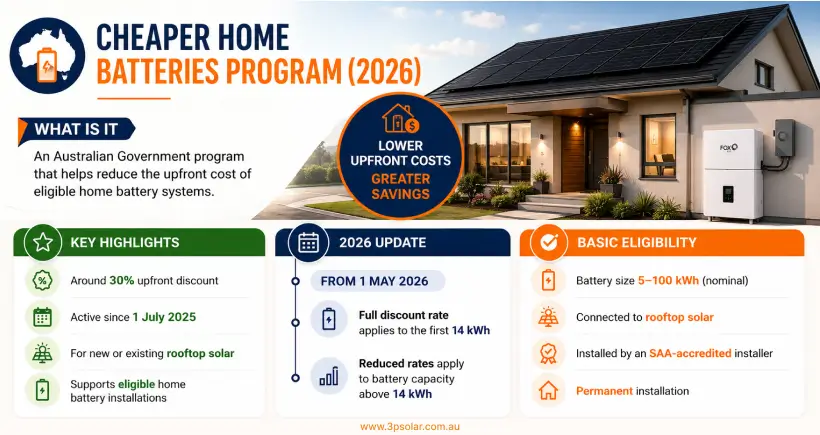
It's an ACTIVE Australian Government initiative providing a discount of around 30% on the upfront cost of installing an eligible small-scale solar battery system, connected to new or existing rooftop solar.
It has been running since 1 July 2025 and delivered through the Small-scale Renewable Energy Scheme (SRES), the same federal mechanism that has funded solar panel discounts since 2011.
In December 2025, the government expanded the program, lifting estimated funding from $2.3 billion to around $7.2 billion over four years, aiming to help more than 2 million Australians install a battery by 2030.
How the Discount Actually Works
Rather than a cash rebate, the federal battery rebate is delivered through Small-scale Technology Certificates (STCs), tradeable certificates your installer typically claims on your behalf and passes on as an upfront price reduction, so most households never handle the certificates themselves.
The number of STCs your battery generates depends on its usable capacity and an “STC factor” set by the government.
STCs are only created for the first 50 kWh of a battery's usable capacity. Batteries up to 100 kWh in nominal capacity remain eligible for installation under the program, but nothing above 50 kWh attracts a certificate.
What Changed on 1 May 2026?
Two changes took effect on 1 May 2026, following amendments to the Renewable Energy (Electricity) Regulations 2001 finalised on 5 February 2026.
The STC factor now steps down twice a year instead of annually, a deliberate response to falling battery prices.
The bigger change for most households is that the discount now tapers by battery size. According to the Clean Energy Regulator, the STC factor now applies in bands:
| Usable Battery Capacity (kWh) | STC Factor Applied |
|---|---|
| 0–14 kWh (inclusive) | 100% (Full STC factor) |
| Above 14 kWh to 28 kWh | 60% of the STC factor |
| Above 28 kWh to 50 kWh | 15% of the STC factor |
Think of it like a tax bracket: a 20 kWh battery still gets the full rate on its first 14 kWh, then the reduced 60% rate on the remaining 6 kWh.
The goal, per the Clean Energy Regulator, is to keep the home battery rebate at roughly 30% for small, medium and large systems while discouraging oversized systems well beyond typical household needs.
Are You Still Eligible?
The underlying eligibility rules haven't changed. To qualify, your battery generally needs to:
- Have a nominal capacity between 5 kWh and 100 kWh
- Be connected to new or existing rooftop solar (battery-only systems without solar aren't eligible)
- Be installed for permanent use, not intended to be moved or resold
- Be installed by a Solar Accreditation Australia (SAA) accredited battery installer
- Have its electrical wiring completed by a licensed electrician
Can You Combine It With a State Rebate?
It depends on your state. In NSW, for example, the state government's own battery discount was suspended once the federal program launched, because the federal discount is larger.
NSW households can still combine the federal discount with the separate NSW incentive for connecting a battery to a Virtual Power Plant (VPP). Rules differ by state, so check what's available where you live before committing to a system size.
How Much Could You Save?
Every household's savings depend on usage, solar system size and battery size, so we won't put a single number on it here. As one real-world illustration, the government's own SunSPOT modelling for an example household found a 6.6kW solar system-only setup saving around $1,600 a year, compared with around $2,100 a year for the same home with a battery added.
These figures reflect that particular household's usage, not a guarantee for every home. For a personalised estimate based on your own bill, the government's free SunSPOT calculator is a good starting point before you speak with any retailer; or explore 3P Solar's solar and battery packages directly.
How to Claim the Discount
You generally don't need to apply separately. SAA-accredited installer applies the discount at the point of quote, using your battery's usable capacity and the STC factor current on your installation date.
Ask your installer to show you exactly how the discount calculated, so you can see it reflects the current bands.
Program Status at a Glance
| Program | Status | Notes |
|---|---|---|
| Federal Cheaper Home Batteries Program | ACTIVE | ~30% discount, live since 1 July 2025; recalculation changes from 1 May 2026 |
| NSW state battery discount | SUSPENDED | Suspended once the federal program launched (federal discount is larger) |
| NSW VPP incentive | ACTIVE | Can be combined with the federal discount |
Eligibility Checklist
- Battery is 5–100 kWh nominal capacity
- Connected to new or existing rooftop solar
- Installed for permanent use (not portable/resold)
- Installed by an SAA-accredited installer
- Wiring completed by a licensed electrician
- Checked whether a state incentive can stack with the federal discount

Key Takeaways
- The Cheaper Home Batteries Program is ACTIVE, offering around a 30% discount on eligible batteries
- Two changes commenced 1 May 2026: the STC factor now steps down twice yearly, and the discount tapers above 14 kWh
- Eligibility rules are unchanged; battery-only systems without solar still don't qualify
- State rebate stacking rules vary; check your own state before choosing a system size
Frequently Asked Questions
Around 30% of the upfront cost of an eligible battery, though the exact value depends on your battery's usable capacity and the STC factor on your installation date.
The program scheduled to run with declining STC factors through to 2030, reviewed at least annually, with step-downs twice yearly from 1 May 2026 onward.
Yes. The program supports batteries retrofitted to existing rooftop solar, as well as batteries installed alongside a new system.
No. it's a discount of around 30% on the upfront cost, not a full subsidy.
In some cases, but rules vary by state. Some state battery discounts have been suspended since the federal program launched, though separate incentives like VPP participation rewards may still stack.