Is a Solar Battery Worth It in 2027?
For many Australian homes, yes. A solar battery is most likely to be worth it if you export a lot of daytime solar, use most of your power in the evening, and choose a battery sized to that evening use. The federal battery discount is active in 2026 but steps down again on 1 January 2027.
The federal Cheaper Home Batteries Program approved more than 438,000 battery installations in its first year, according to the Clean Energy Regulator. So are solar batteries worth it for your home? That comes down to a few things you can check on your power bill.
When a solar battery is worth it, and when it isn't
A battery pays its way by storing solar you would otherwise export for a few cents, then running your home after sunset. The more of that swap you make each day, the stronger the case.
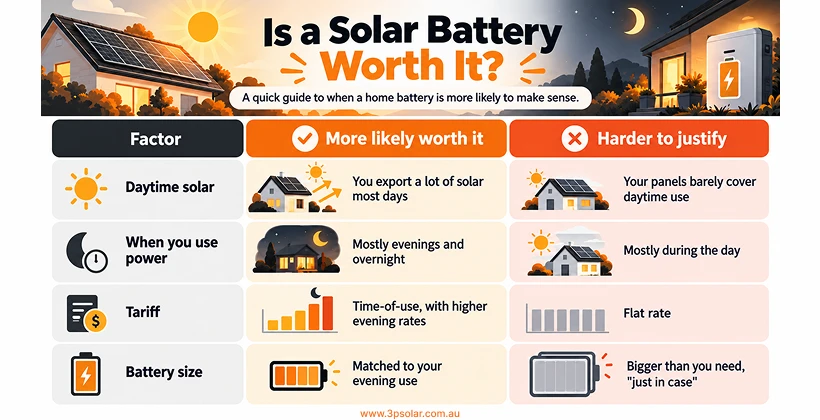
Solar Victoria's battery buyers guide agrees: time-of-use tariffs generally suit solar better than flat tariffs, and homes with large systems and high usage suit battery retrofits best.
A 10kW solar system or 13kW solar system generally leaves more spare energy to store than a 6.6kW system. New to solar? Read how solar panels work.
Why low feed-in tariffs make a battery more useful
Feed-in tariffs are low, so solar you use yourself is usually worth more than solar you sell. In NSW, IPART's 2026-27 benchmark for all-day feed-in tariffs is 3.4 to 6.5 c/kWh, and retailers don't have to offer it. In Victoria, the Essential Services Commission stopped setting a minimum feed-in tariff from 1 July 2025, so retailers set their own rates, with a floor of zero.
IPART says solar's biggest benefit is using what you generate. A battery carries that benefit into the evening.
The federal battery rebate
The Cheaper Home Batteries Program is active. It gives an upfront discount through small-scale technology certificates (STCs), which the Clean Energy Regulator says equates to around 30% of the installation cost.
What changed on 1 May
Support is now tiered by usable battery capacity, and only the first 50 kWh can earn STCs.
| Usable battery capacity | Share of the STC factor applied |
|---|---|
| First 14 kWh | 100% |
| Above 14 kWh, up to 28 kWh | 60% |
| Above 28 kWh, up to 50 kWh | 15% |
| Above 50 kWh | No STCs |
Each kWh above 14 kWh earns less support, so a bigger battery only pays off if you'll regularly use the extra storage.
What changes on 1 January 2027
The STC factor falls from 6.8 to 5.7 per kWh, then drops every six months until the end of 2030. The CER says the installation date, not the contract date, sets the rebate, and has warned installers not to rush jobs. Get a realistic date in writing.
Eligibility in brief
To qualify (see our solar rebate page), the battery must:
- be on the Clean Energy Council approved list
- be able to join a virtual power plant (VPP)
- be installed by an SAA-accredited installer with battery endorsement
- comply with AS/NZS 5139:2019
- be paired with new or existing solar (up to 100 kW)
Where the Solar Sharer Offer fits
Since 1 July 2026, households in NSW, South East Queensland and South Australia can opt in to the Solar Sharer Offer: three free hours of electricity a day. Energy Made Easy lists the window as 11am to 2pm (NSW, South East Queensland) and 12pm to 3pm (South Australia), up to 24 kWh a day.
It doesn't replace a battery, whose main job is the evening. energy.gov.au lists a home battery as one way to shift usage into the free window, so ask how the two would work together before you switch.
Other benefits of a solar battery
- Blackout backup, if it's set up for it. Backup isn't a rebate requirement, so confirm it's included. See our solar battery systems options.
- A VPP option. Rebate-eligible batteries must be able to join a VPP. In WA, joining is a condition of the state rebate.

Checklist: is a battery worth it for your home?
- Check your bills for how much solar you export and how much power you buy after dark.
- Confirm whether you're on a time-of-use or flat tariff.
- List evening loads like cooking, heating, cooling and EV charging.
- Size the battery to that evening use, keeping the 14 kWh and 28 kWh rebate tiers in mind.
- Confirm the battery is CEC-listed and the installer is SAA-accredited.
- Get the planned installation date in writing, since that date sets the rebate.
Existing 3P Solar customers can contact our support team about adding a battery. New customers can compare solar and battery packages.
Key takeaways
- A battery suits homes that export a lot of solar and use most power in the evening.
- The federal discount is active, tiered by size since 1 May 2026, and steps down on 1 January 2027.
- Size the battery to your evening use, not the biggest rebate.
Frequently Asked Questions
For many homes, yes, especially those that export a lot of solar and use most power in the evening. The federal discount is active but tiered by size and steps down on 1 January 2027.
It can be. Eligible batteries added to existing systems can claim the federal discount, and homes with large systems and high usage tend to suit retrofits best.
It depends on your usage, tariff and battery size. Solar Victoria's buyers guide says a battery should ideally pay for itself within around 10 years.
No. It doesn't require solar or a battery, though a battery is one way to shift usage into the free window.
Find out if a battery suits your home
Speak with a 3P Solar expert about your home solar system, your evening use and a battery size that fits. 3P Solar, a 2025 ProductReview.com.au Award winner, installs across NSW, QLD, SA, WA and VIC.