Virtual Power Plants Explained: Is Joining One Worth It with a Home Battery?
A virtual power plant (VPP) links your home battery into a network of other batteries so the operator can draw on that stored energy when the grid is under strain, and pays you for it. South Australia runs a government-backed VPP, and NSW offers a separate incentive for connecting a battery to a private VPP. Whether it beats a standard feed-in tariff depends on your battery size, how often events are called, and what the contract pays.
What Is a Virtual Power Plant?
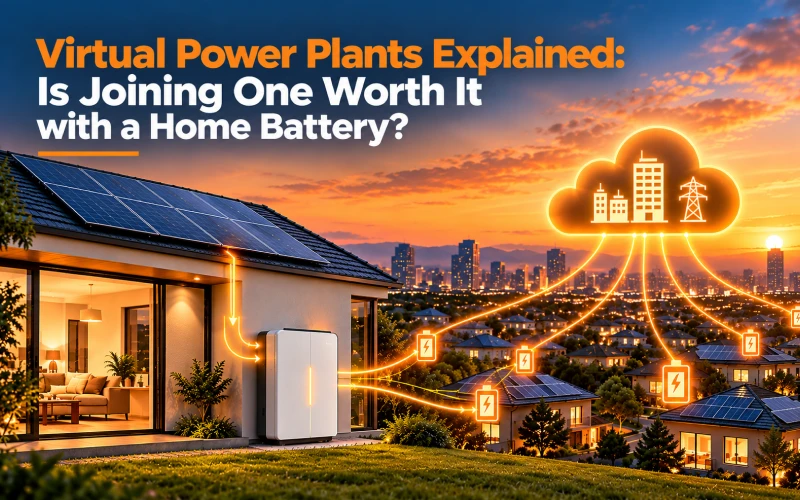
A virtual power plant isn't an actual power station. It's software that links hundreds or thousands of home batteries into one coordinated network, so together they act like a single, much larger battery the grid operator can call on. When the grid is under stress, say a heatwave pushing air conditioners hard, the operator asks each connected solar battery to release a small amount of stored energy back into the grid at the same time, and pays you for it.
You don't lose control day to day. Most contracts reserve only a portion of your battery's capacity, commonly 10–30%, for these events, and let you set a minimum charge level the provider can't go below.
How Does a Virtual Power Plant Actually Work?
Your battery has to be on the provider's approved list, you sign up with a VPP operator (large energy retailers, battery manufacturers and independent aggregators all run offers, including AGL, Origin, Amber and Tesla), and their software then manages that small slice of your battery.
Each provider sets its own compatible-battery list, event frequency and payment structure, so read the actual contract rather than the marketing page. Once connected, an event is called typically a handful of times a month, more often over summer, and paid through a mix of a joining bonus, an ongoing credit and per-event payments.
Virtual Power Plant vs a Standard Feed-in Tariff
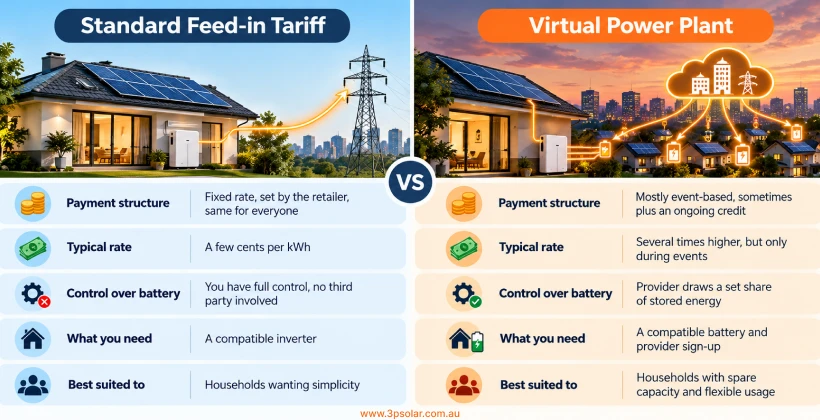
A feed-in tariff pays a fixed rate for every kilowatt-hour of solar you export, all year round. A VPP instead pays mostly for energy your battery releases during a limited number of grid events, usually at a considerably higher rate.
| Standard feed-in tariff | Virtual power plant | |
|---|---|---|
| Payment structure | Fixed rate, every export, year-round | Mostly event-based, sometimes plus an ongoing credit |
| Typical rate | A few cents per kWh | Several times higher, but only during events |
| Control over battery | Full, no third party involved | Provider draws a set share during events |
| What you need | A compatible inverter | A compatible battery and provider sign-up |
| Best suited to | Households wanting simplicity | Households with spare capacity most nights |
For many homes it's not either/or — stay on your feed-in tariff for daytime exports, and add a VPP for the stored energy your solar package would otherwise leave unused overnight.
Government-Backed VPP Programs in Australia
State program currently stand out, and active.
NSW's Virtual Power Plant incentive, under the state's Household Energy Saving Upgrades program, helps cover the cost of connecting a new battery to a private VPP and can be combined with the federal Cheaper Home Batteries Program discount. Status: Active. Source: energy.nsw.gov.au. The exact incentive amount is reviewed periodically, so check the current figure on the NSW page rather than relying on a fixed number.
A virtual power plant in Victoria, Queensland or Western Australia works differently: none of those three states runs its own program, so a household there joins a private retailer's VPP instead. Across Australia, AEMO also runs virtual power plant demonstration projects testing how these networks support the wider grid.
Is a Virtual Power Plant Worth It for Your Home?
For a battery that's often mostly full overnight, a VPP can add real income on top of solar savings. For a smaller battery already working hard covering evening use, giving up 10–30% of capacity for events may leave little spare to trade away. It comes down to battery size, usage pattern and the specific contract, not a blanket answer.
How to Check If Your Battery Is VPP-Ready
- Confirm your exact battery model is on the provider's compatible-battery list, not just the brand.
- Check whether your state runs a government-backed program (currently SA and NSW) or only private offers.
- Read the reserved-capacity and minimum-charge terms before signing, and ask what events cost and paid last year.
- Confirm joining won't affect your feed-in tariff or battery warranty.
- Ask your installer which VPP programs your battery and inverter combination supports.

Key Takeaways
- A VPP links your battery into a coordinated network so the grid operator can draw on it during events, and pays you for that energy.
- South Australia's government VPP and NSW's VPP incentive are both active; QLD, VIC and WA rely on private retailer VPPs only.
- A VPP pays mostly for a limited number of events at a high rate; a feed-in tariff pays a lower rate on every export, all year.
- Whether it's worth it depends on battery size, usage pattern and contract, not a blanket answer.
- Not every battery qualifies — check the provider's approved list before assuming yours is eligible.
Frequently Asked Questions
A network of home batteries coordinated by software to act together like one larger power source, supplying the grid with stored energy when needed.
Depends on battery size and usage. Households with spare capacity overnight get the most value; households already using most of their battery day to day have less to trade away.
The software automatically draws a set share of your stored energy during grid events, typically a handful of times a month, and pays you for it.
Not necessarily. Many households keep their feed-in tariff for daytime exports and add a VPP for battery capacity that would otherwise go unused overnight.
No. Each provider keeps its own approved-model list, so check your specific battery rather than assuming a compatible brand.