
Solar Battery Rebate Changes in 2027: What Australian Homeowners Should Know
The federal battery discount steps down twice in 2027: on 1 January and again on 1 July. The rebate doesn't end. It keeps reducing every six months under the published schedule. Your discount depends on your eligibility, your battery's usable capacity, and the date it's installed.
The federal battery rebate comes from the Cheaper Home Batteries Program. An eligible battery earns small-scale technology certificates (STCs), and your retailer usually turns those into an upfront discount on your quote. Here are the solar battery rebate changes coming in 2027, in plain English. When choosing a solar battery system, consider your household's energy needs alongside the available upfront discount.
What Solar Battery Rebate Changes Apply in 2027?
The number of STCs earned per kWh of battery storage, called the STC factor, drops on 1 January 2027 and again on 1 July 2027.
Solar Battery Rebate 2027: Key Dates
| Installation period | Base STC factor (before capacity tapering) |
|---|---|
| 1 May to 31 December 2026 | 6.8 |
| 1 January to 30 June 2027 | 5.7 |
| 1 July to 31 December 2027 | 5.2 |
A few things worth knowing:
- The factor helps work out how many certificates your battery earns. It isn't a dollar amount or a set percentage off.
- The published schedule keeps stepping down every six months until the end of 2030. The rebate doesn't finish in January 2027.
- The installation date sets your rate, not when a contract is signed. Your quote date and deposit date don't lock it in.
How Do Federal Battery Rebate Changes Affect Your Quote?
The federal battery rebate changes in 2027 sit on top of capacity tapering that started on 1 May 2026:
- the first 14kWh of usable capacity gets the full factor
- each kWh from 14 to 28kWh gets 60% of the factor
- each kWh from 28 to 50kWh gets 15% of the factor
Those percentages apply to the STC factor, not to the price of your battery. Your final discount also depends on what the certificates are worth, which isn't fixed, and how your retailer applies them in your quote.
So each solar battery rebate reduction means fewer certificates for the same battery. It doesn't tell you the exact dollar change on your quote.
Federal Battery Rebate Eligibility: Who Qualifies?
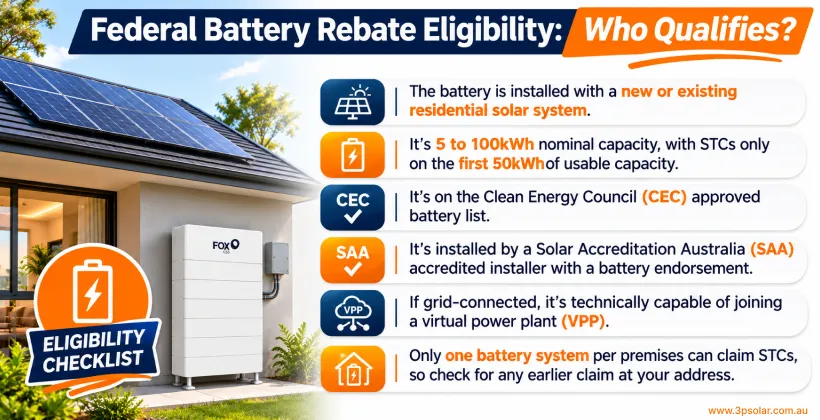
Here are the key checks under the Clean Energy Regulator's rules:
- the battery is installed with a new or existing residential solar system.
- it's 5 to 100kWh nominal capacity, with STCs only on the first 50kWh of usable capacity
- it's on the Clean Energy Council (CEC) approved battery list
- it's installed by a Solar Accreditation Australia (SAA) accredited installer with a battery endorsement
- if grid-connected, it's technically capable of joining a virtual power plant (VPP)
- only one battery system per premises can claim STCs, so check for any earlier claim at your address
What's the difference between nominal and usable capacity? Nominal is the full size on the label. Usable is how much energy you can actually draw out, and it's what the STCs are based on.
Why Choose a NETCC Approved Seller?
As a NETCC Approved Seller, 3P Solar can help explain battery options, rebate assumptions and the details to check in your quote. Under the New Energy Tech Consumer Code, you can expect:
- clear rebate calculations and eligibility explanations
- a written quote showing what's included, what's not and the assumptions used
- realistic installation timeframes and ongoing support
NETCC approval doesn't guarantee your eligibility. Your battery and installation still have to meet the program's rules.
How Should Homeowners Plan Their Battery Purchase?
A bigger rebate doesn't automatically make a battery the right one for you. Before you sign, compare:
- battery size against your electricity use and how much your solar panels generate
- total installed cost, warranties and whether you need blackout backup
- the expected installation date, and what happens to your price if it moves
- any state rebates and whether they can be combined
The CER recommends you get multiple quotes and choose the right size. Sizing matters: you can't claim STCs again for a second battery at the same premises later. Battery rebate changes are a reason to check timing, not a reason to rush. If an installer can't confirm a date, ask what happens to your quote.

Conclusion
The solar battery rebate changes in 2027 lower the STC factor on 1 January and again on 1 July. Your installation date sets your rate. The right-sized system and a clear written quote still matter more than chasing a deadline.
FAQs
They change the number of small-scale technology certificates available, which can affect an eligible battery’s upfront discount.
No, the applicable factor depends on installation and certification, rather than contract or deposit dates.
Yes, an eligible battery can connect to an existing solar system, subject to the program’s requirements.
No, equipment, installation, solar connection and previous battery claims at the premises must meet eligibility requirements.
No, capacity tapering reduces the STC support applied to additional storage above specified capacity thresholds.
Not necessarily. Equipment costs, installation requirements, certificate values and retailer pricing also affect your final quote.
